 CX manager & race game
In Cyclocross is Boss a week doesn’t just “happen”: you plan it. Seven days, one box per day, and for each a decision — rest, ride endurance, do intervals, line up for a race… Here is how the schedule works, and why every box matters.
1. The schedule: one box per day

The “Schedule” screen shows the season calendar week by week. For the current week, every day offers a drop-down list of sessions. Opening it immediately shows the effect of each session (fatigue, load) — taking the day’s weather into account — and, at the end of the row, the weekly total that updates with every change. Once the week looks right, you validate it.
Some boxes are already taken: a race (registered), a long trip to get there, a press interview, a health setback (sleepless night, stomach trouble) or a weather episode (downpour, storm, black ice) that makes outdoor training impossible. Planning also means working with what the week imposes.
Le moral, lui, ne monte pas à l’entraînement : il se gagne par les résultats, la sélection en Coupe du monde et… une bonne gestion de la charge.
2. Sessions: nine options, different effects
| Session | Load | Fatigue |
|---|---|---|
| Rest | −2 | −3 |
| Active Recovery | +1 | −1 |
| Pre-Race | +2 | +1 |
| Base Endurance | +2 | +1 |
| CX Technique | +3 | +1 |
| Home Trainer | +3 | +1 |
| Tempo Intervals | +4 | +2 |
| VO2 Max Intervals | +6 | +3 |
| Race Simulation | +6 | +3 |
| C2 / C1 / World Cup race | +8 / +10 / +12 | +4 / +5 / +6 |
Morale does not go up in training: it comes from results, World Cup selection and… good load management.
3. Five gauges to keep an eye on
- Load (0–20): the accumulated training volume. It fades by 16% every day.
- Fatigue (0–20): it rises with hard sessions and drops slowly (−0.3/day) — rest remains the real cure.
- Morale (0–20): fed by results and a well-dosed load.
- Form (−3 to +3): the outcome of all this (see our article on form).
- Vulnerability (0–5): the risk of falling ill.
4. The ideal load zone: 15 to 17
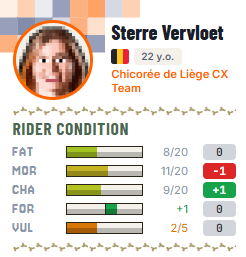
In the 15–17 zone, morale gains a little every week. Below or above it, it loses a few points depending on the gap. At 18 and over it’s overload: form drops and vulnerability climbs. And if the load stays very low while the rider is fresh, that’s under-training: form drops as well.
A rider who is too tired (13 and above) loses morale every week. Pushed too far (very high fatigue and high vulnerability), they are put on forced rest by the team doctor.
5. L’équilibre des intensités sur 14 jours
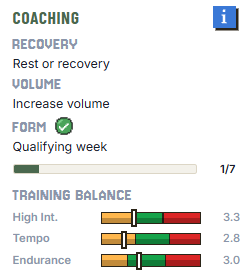
To stop players repeating the same session all week, the game looks at the last 14 days and sorts them into three zones: high intensity (VO2 max, races…), tempo and endurance. Each has a target. If all three are on target, the balance is “good”; with two out of three, “partial”; otherwise “poor”. That verdict directly weighs on form progression — and, on race day, on the rider’s endurance.
The left column shows it permanently: three bars, with a marker in the green zone when everything is fine.
6. The weather gets involved
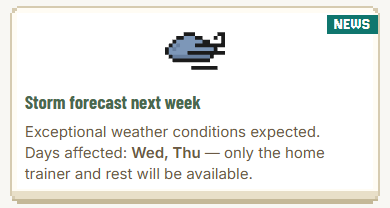
Outdoor sessions aren’t worth the same in sunshine and in rain: a hard session in dreadful weather costs morale (even vulnerability). Conversely, the home trainer is a good idea when it rains — it even lifts morale — and a poor one when it’s nice out..
7. Technical training, on its own
Technique doesn’t improve with form. Each CX Technique (or Race Simulation) session counts in a sliding window of four weeks: six sessions, and the rider gains +1 technique (up to +3). Conversely, a whole week without any qualifying session sets you back a notch.
8. And the coach?
In the left column, a small “Coaching” box turns all this into advice: “well recovered”, “increase the volume”, “high-intensity range too low”… No mental arithmetic: the game tells you where you stand, and it’s up to the player to decide what to do about it.
In short
A schedule is seven decisions, five gauges, a 14-day balance and unpredictable weather. Filling it in well means reaching Sunday with a fresh, motivated rider in form — or having pushed a little too hard.